Helping millions of people successfully contribute
platforms
iOS, Android, Web
Year
2024 → 2026
My Role
Lead Product Designer
Overview
Contributor growth had plateaued and Reddit didn’t have a shared model for how to change it.
Teams had tried over the years to change this, but the contributor journey remained fragmented across products and organizations. I led the effort to reframe contribution as a behavioral system, identify contributor confidence as a high-leverage opportunity, and turn that strategy into a connected system spanning eligibility, AI guidance, community recommendations, and recovery.
Impact
+27%
Poster retention
16% ↓
Content removals
+5.2%
Successful posts per user
The work gave Reddit a shared strategy for contributor growth and turned contributor confidence into a product system teams could invest in across the journey. It reduced preventable failures before and during posting, helped more contributors recover when things went wrong, and established reusable infrastructure for smarter guidance across creation. By 2026, contributor growth had begun reversing its historical trend against logged-in consumer growth.
Team & Partners
Product, Engineering, Machine Learning, Moderation, Community, Legal, Research, Data Science, Content Design, Executive Leadership
When Growth Stopped Compounding
Spring 2024. Reddit continued growing rapidly. Millions of people visited communities every day to learn, ask questions, and participate in conversations. Logged-in DAU continued climbing, yet contributor growth had largely plateaued.
The conversations that made Reddit valuable depended on a healthy ecosystem of contributors. As consumption continued outpacing contribution, leadership needed confidence that this was still a solvable problem before investing further.
This wasn't a new problem. Teams across the company had already invested in onboarding, posting, moderation, notifications, recommendations, and experimentation. While individual initiatives showed promise, none meaningfully changed contributor growth across the broader ecosystem.
Part of the challenge was structural. Reddit was organized around products and capabilities: posting, comments, notifications, moderation, recommendations, onboarding, and search. Planning naturally revolved around improving the surfaces each team owned. Contributors never experienced Reddit that way. They experienced one continuous journey.
Following Reddit's IPO, growing the company's content inventory became a strategic priority. Rather than beginning with another feature idea, our small team was asked to answer a more fundamental question:
How do we sustainably create more contributors?
Before deciding what Reddit should build, we first had to decide how Reddit should think about contributor growth.
Building a Shared Understanding
Before recommending where Reddit should invest next, we needed to understand contributor behavior from end to end. I led a three-day strategy workshop with Product, User Research, and Data Science to synthesize years of research, behavioral data, contributor journeys, moderation patterns, retention metrics, and previous product investments that had lived across separate teams. We also looked beyond Reddit, drawing from behavioral psychology and habit formation research to better understand why people choose to contribute and why they stop.
This surfaced an important organizational blind spot. Most internal product conversations reflected how people inside Reddit consumed content rather than how contributors experienced creating it. Because the most visible problems were often interface problems, the less visible emotional uncertainty surrounding contribution was easy to overlook.
As we mapped the full journey, two patterns consistently emerged:
The biggest barriers weren't primarily usability problems. People hesitated because they weren't confident their contribution belonged, didn't know what was expected of them, or weren't sure participating would be worth the effort.
Success wasn't determined at submission. Whether someone contributed again depended heavily on what happened afterward: whether they received feedback, felt seen, recovered from failure, or developed a stronger sense of belonging.
The work became more than research synthesis. Through behavioral frameworks, journey mapping, and repeated cross-functional workshops, we created a shared mental model teams could use to reason about contributor growth together.
By the end, dozens of disconnected product problems had begun to look like parts of one behavioral system.
Choosing a New Operating Model
As our understanding evolved, we faced an important decision: How should Reddit organize its contributor strategy? This wasn't simply a framework for design. The model we chose would shape how teams across the company understood opportunities, prioritized investments, and measured contributor growth.
We chose a behavioral flywheel. Rather than organizing the strategy around products that would inevitably change, we organized it around psychological needs that were more durable: motivation, confidence, reinforcement, and belonging.
We accepted the short-term cost of introducing a new model because it allowed us to make decisions around human behavior rather than organizational boundaries.
The model described contribution as four connected phases:
Trigger: Creating the motivation to participate. Before someone contributes, they need a reason to do so. We focused on moments where participating felt personally relevant, timely, and emotionally safe, shifting the question from “How do we get people to post?” to “How do we create moments that naturally invite contribution?”
Action: Turning confidence into action. Motivation wasn't enough. People often wanted to contribute but hesitated because they weren't sure where their contribution belonged, what was expected of them, or whether they might make a mistake. This phase focused on helping people feel ready to act.
Feedback: Helping contributors feel their effort mattered. Submitting something wasn't the end of the journey. What happened afterward helped determine whether someone returned. Feedback could reinforce confidence, create momentum, and show contributors that their participation had value.
Investment: Strengthening identity and belonging. Long-term participation depended on contributors beginning to see themselves as members of a community. This phase focused on strengthening relationships, recognizing progress, and building a deeper sense of belonging.
Finding the Highest Leverage Opportunity
The flywheel gave us a common language. Its real value was helping us decide where to invest.
We evaluated opportunities across the contributor journey using research, behavioral data, expected impact, organizational confidence, and implementation effort.
One opportunity consistently rose above the others:
The largest opportunity wasn't making contribution easier. It was helping people feel confident enough to contribute.
Research showed that contributors often wanted to participate but were uncertain whether they could post, where their content belonged, what communities expected, or what to do when things went wrong.
What had looked like separate product problems were different expressions of the same underlying need: confidence.
Designing the Confidence System
Confidence wasn't something we could solve with a single feature. It broke down at different moments for different reasons: contributors didn't know whether they could participate, where their content belonged, whether it met community expectations, or what to do when a contribution failed.
Instead of organizing the work around individual product surfaces, we designed a support system around three moments in the contributor journey:
Before posting: help people know they can participate.
Surface eligibility and community expectations before someone invests time creating, and guide them toward better alternatives when they can't contribute yet.
While composing: help people make better decisions.
Use contributor intent to recommend the right communities and provide AI-powered guidance while someone is writing, before uncertainty becomes a mistake or removal.
After posting: help people recover and continue.
Treat removals, abandoned drafts, and low engagement as recoverable moments by helping contributors find another path forward rather than leaving the journey.
Across all three moments, the strategy was the same: reduce uncertainty early and create a path forward when things went wrong.
That became the system behind the investments that followed.
Proactive Eligibility Guidance
Can I contribute here?
Many contributors only discovered that they didn’t meet a community’s participation requirements after investing time creating a post.
The rules were working as intended. The experience around them wasn’t.
We moved eligibility guidance earlier in the journey, but doing so introduced a harder design problem: how do you explain a restriction without exposing the rule itself?
I designed the experience around four principles: signal constraints before effort is wasted, show progress without revealing thresholds, give contributors a concrete path forward, and preserve their intent by routing them somewhere they could participate.
This turned eligibility from a hidden moderation mechanism into a contributor-facing capability. The same signal could work across community pages, creation, recommendations, and recovery, creating a reusable foundation for guiding people toward successful participation.
AI Powered Community Recommendations
Where does this belong?
Nearly 30% of contributors started creating outside of a community.
When they eventually opened the community picker, recommendations were primarily based on communities they had recently visited or joined. That reflected where someone had been, not necessarily what they were trying to contribute.
Our hypothesis was that understanding the content itself could help people find communities where their contribution was more likely to succeed.
The existing recommendation pipeline relied on embeddings and a logistic regression classifier. Initial experiments showed promise, but also exposed the limitations of a system built primarily around historical behavior. We evolved toward an LLM powered approach capable of reasoning about the meaning of a post and matching that intent against potential communities.
Recommendations combined two signals: intent, whether the community was relevant to what someone was trying to post, and eligibility, whether that contributor could actually participate there.
Once enough content existed to infer intent, eligible, high confidence recommendations appeared at the top of the community picker.
This created a reusable content routing capability that could later support both initial community selection and recovery after unsuccessful outcomes.
AI Powered Contributor Guidance
Will this be successful here?
Finding the right community solved only part of the problem. Contributors still had to understand hundreds of different community norms and rules while creating their posts.
Research consistently showed that people preferred guidance before something was removed, when they still had an opportunity to fix it.
As Reddit's AI moderation capabilities expanded, we moved that intelligence upstream into creation. Rather than introducing another button or continuously evaluating someone while they typed, we embedded guidance directly into the existing submission flow.
The interaction became: Write → Post → Check → Resolve if needed
Instead of repeated background inference throughout composition, the system made one LLM call when the contributor tapped Post, reducing unnecessary model usage while making the intervention feel more intentional.
We also simplified the experience by consolidating relevant community rules into a single list, helping contributors quickly understand what needed attention while keeping them in control of the final decision.
We made sure to build out configurable settings to provide control to communities.
Improving the interface was only part of the work. We also built new internal tooling that allowed faster prompt iteration, evaluation across newer models, and independent measurement before changes reached production.
We evaluated performance against a labeled golden set of posts and pre launch samples of live Reddit content, measuring:
Precision: How often predicted violations were actually violations
False positive rate: How often valid posts were incorrectly flagged
Recall: How many true rule violations the system successfully detected
Jaccard score: Whether the model correctly identified the specific rules being violated
This created a tighter loop between prompt engineering, model evaluation, product behavior, and contributor experience.
Removal Recovery
Can this contribution still succeed?
A removed post didn't necessarily mean the contribution itself was poor. Often, it meant the content had been created for the wrong community or didn't satisfy that community's requirements.
We treated removal as a routing problem. After a removal, contributors could receive recommendations for alternative communities where their existing content was a better fit, reusing the same content understanding, recommendation, and eligibility capabilities developed earlier in the journey.
Instead of asking someone to start over, Reddit could help an existing contribution find another path forward.
Draft Recovery
Do I still want to finish this?
Many contributions never reached submission at all. Contributors could get distracted or leave after already investing time creating something.
Timely push notifications returned contributors directly to their unfinished work, restoring the draft inside the composer. When community selection was part of the friction, recommendations could also help identify where the post belonged.
The experience preserved work contributors had already invested in while reducing the effort required to continue.
When a community is selected
When we have a strong recommendation match
Post Insights
Did my contribution matter?
What happened after publishing helped shape whether contributors understood their impact and wanted to participate again.
We reframed Post Insights from a passive analytics destination into a more active feedback loop. Insights became easier to discover directly from a post, performance became more legible, and contributors received actionable next steps and timely notifications when there was something meaningful to learn.
Feedback became part of the contribution experience rather than something contributors had to seek out.
Outcomes
+27%
Poster retention
16% ↓
Content removals
+5.2%
Successful posts per user
What began as an effort to understand why contributor growth had plateaued became a connected system for improving successful participation across Reddit.
The work helped contributors avoid preventable failures, improve content before submission, and recover when something went wrong. Individual investments also showed meaningful gains, including a 13% reduction in moderator removals from AI guidance and increases in crossposting through recovery of 54% on Android and 67% on iOS.
Beyond individual experiments, the work established reusable capabilities across eligibility, content understanding, community recommendations, AI guidance, and recovery, giving teams a shared foundation for improving contributor confidence across the creation journey.
It also gave Reddit a unified behavioral model for contributor growth, connecting previously fragmented investments around a shared understanding of what contributors needed to succeed and contributing to a reversal of the historical gap between contributor growth and logged-in audience growth.
Press: Making Reddit Easier: New Tools for Engaging and Contributing, Reddit adds new tools to help users contribute and connect across its platform
Key Learnings
The right model can be more valuable than the right feature. Reframing contributor growth around behavioral needs gave teams a shared way to see connections across previously fragmented problems.
Reducing uncertainty can be a growth strategy. The biggest barrier wasn’t always effort. Often, people simply lacked confidence that they could contribute successfully.
Failure doesn’t have to end the journey. Treating removals, abandoned drafts, and low engagement as recoverable moments helped preserve existing intent instead of forcing contributors to start over.
Reusable capabilities create compounding value. Eligibility, recommendations, content understanding, and AI guidance became more powerful when they could support multiple moments across the contributor journey.
More Featured Work
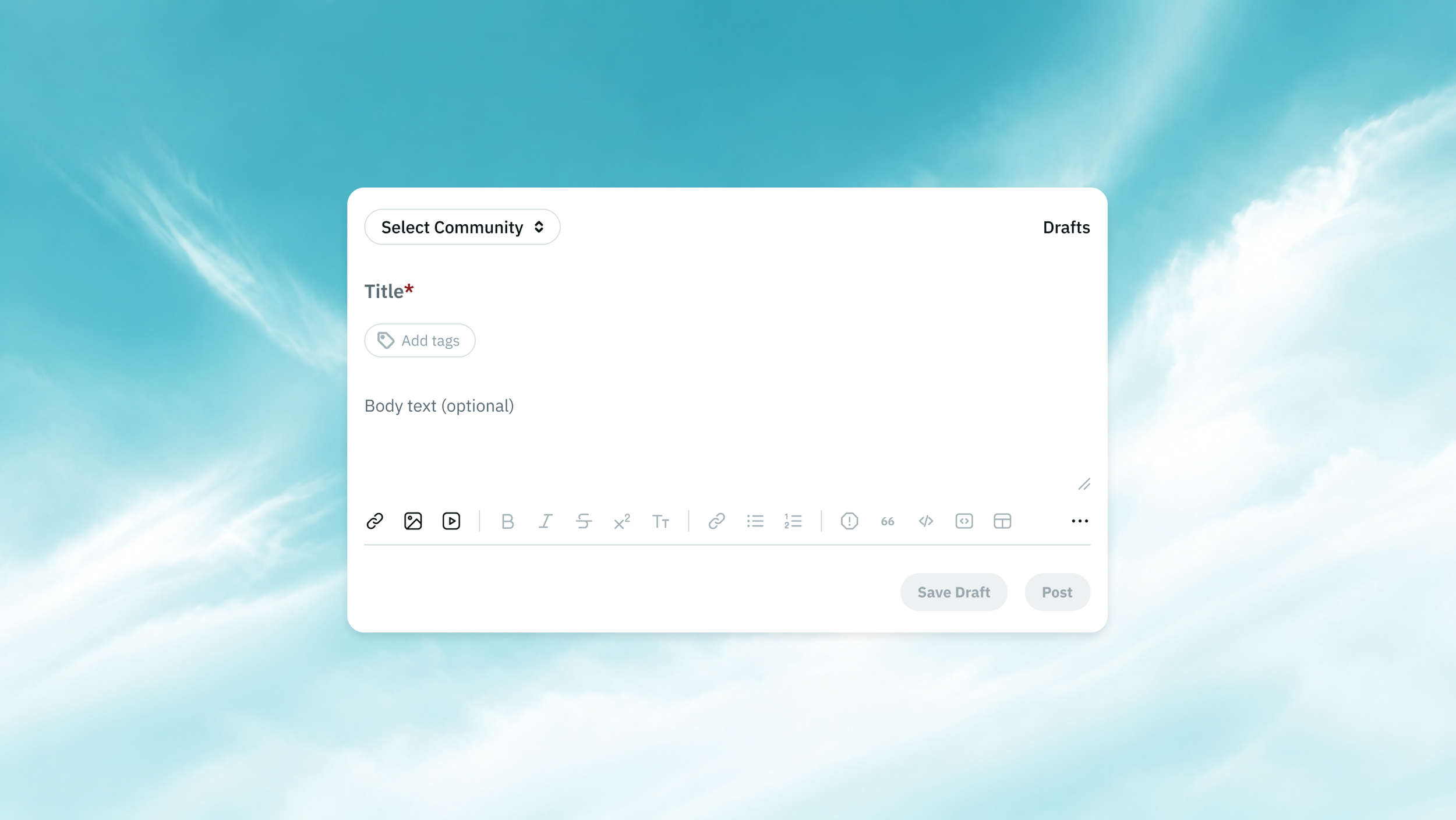
Reimagining how people create at scale
I led the modernization of the web composer, replacing that model with a flexible creation system scalable to all communities on Reddit that could adapt to what contributors were making.
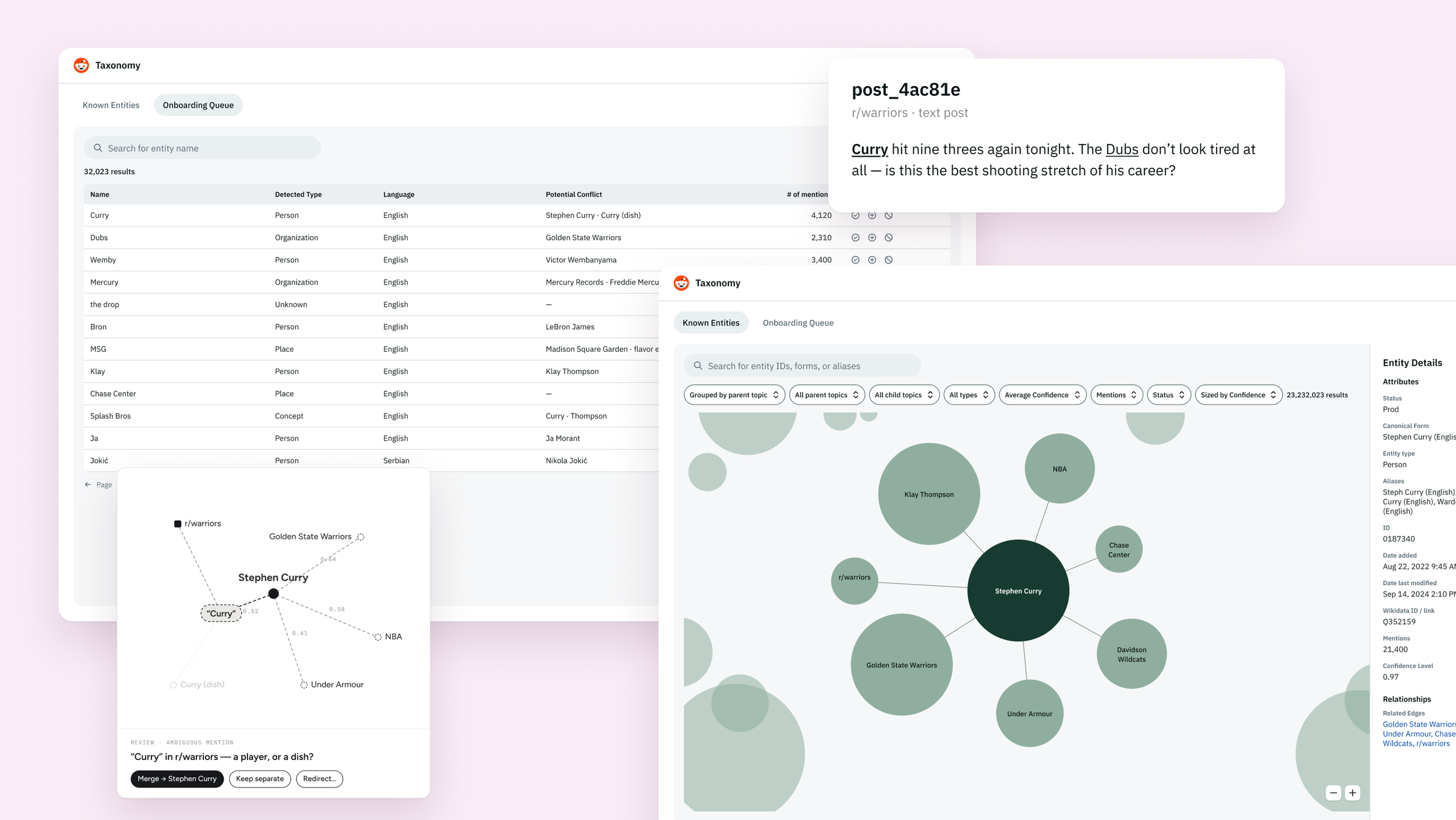
Turning conversations into useful understanding
I led product design for a new content understanding platform that turned fragmented capabilities into reusable semantic infrastructure across Search, Discovery, Recommendations, Advertising, and emerging AI products.